No matter how expensive or high-quality your skincare is,
if breakouts keep coming back and your skin looks dull,
the real cause might not be your face — it could be your gut.
In fact, plenty of people say their skin troubles eased up once their gut felt more settled.
Today, we’ve pulled together the key criteria for choosing the right probiotics for constipation, along with habits that can support probiotic skin care.

Gut health is closely linked to your skin condition.
This article walks through the criteria for choosing probiotics for constipation, the mechanism behind probiotic skin care, and practical lifestyle habits you can start today.

Why Are Gut Health and Skin Connected?
Here’s the short answer: gut environment and skin condition really are connected.
The Gut-Skin Axis refers to the way the balance of gut microbiota can influence skin immunity and inflammatory responses.
When beneficial gut bacteria decline and that balance is thrown off,
waste elimination may become less efficient, which can, in turn, affect skin condition.
On the flip side, when the gut environment is stable,
many people say they feel lighter overall and notice their skin feels calmer.
I’ve personally found my own skin became less reactive after my gut settled down.

A decline in beneficial gut bacteria can affect not just gut balance but skin condition as well.
Having enough beneficial bacteria in your gut may help support gut health and immune balance.
That’s exactly why more people are on the hunt for products like this.
Consistently caring for your gut health can be considered the first step toward better probiotic skin care.

What Criteria Should You Use to Choose Probiotics for Constipation?
In short, check both the actual surviving cell count and the coating technology — not just the number printed on the label.
Guaranteed CFU count refers to the number of live probiotic cells that survive up to the point of consumption, not just at the time of manufacture.
With so many products on the market, it’s not easy to choose.
When picking probiotics for constipation, it helps to run through the following checklist in order.

| What to Check | What to Look For |
|---|---|
| Guaranteed CFU Count | Whether the label lists the guaranteed CFU count at the time of intake, not just the amount added during manufacturing |
| Prebiotics | Whether prebiotic ingredients that feed beneficial bacteria are included |
| Coating Technology | Whether an acid-resistant coating that withstands stomach acid and bile is used |
| Strain Composition | Whether a diverse mix of strains is included in a balanced way |

✅ Check the daily guaranteed CFU count
✅ Check whether prebiotics are included
✅ Check whether a variety of probiotic strains are included
✅ Check whether acid-resistant coating technology is applied
Using these four criteria makes it much easier to find the right probiotic product for you.
If probiotic skin care is a priority for you, it’s worth favoring products with a more diverse strain composition.
What Lifestyle Habits Support Probiotic Skin Care?

Taking a good product alone isn’t the whole picture.
Probiotic skin care means pairing probiotic intake with lifestyle habits that support healthy gut movement.
Drinking a glass of lukewarm water first thing in the morning
may help get your gut moving.
From there, we’d recommend taking probiotics consistently
and making sure to get enough vegetables, fruit, and fiber.
Dietary fiber feeds beneficial gut bacteria and may help build a healthier gut environment.

· Take your probiotics at the same time every day
· Drink about 1.5–2L of water a day
· Get enough vegetables, fruit, and fiber
· Keep a regular sleep schedule and light exercise routine
After keeping up these habits for about three weeks myself,
I heard from others that their gut felt noticeably more comfortable and their skin tone looked clearer than before.
That said, rather than expecting dramatic results overnight,
what matters most is sticking with the habit itself.
If you’d like to compare features across different probiotic products, you can find more information on the Kookmin Bio homepage.
Taking more than the recommended amount doesn’t make it more effective.
What matters is sticking to the intake amount listed on the product, consistently.

Frequently Asked Questions

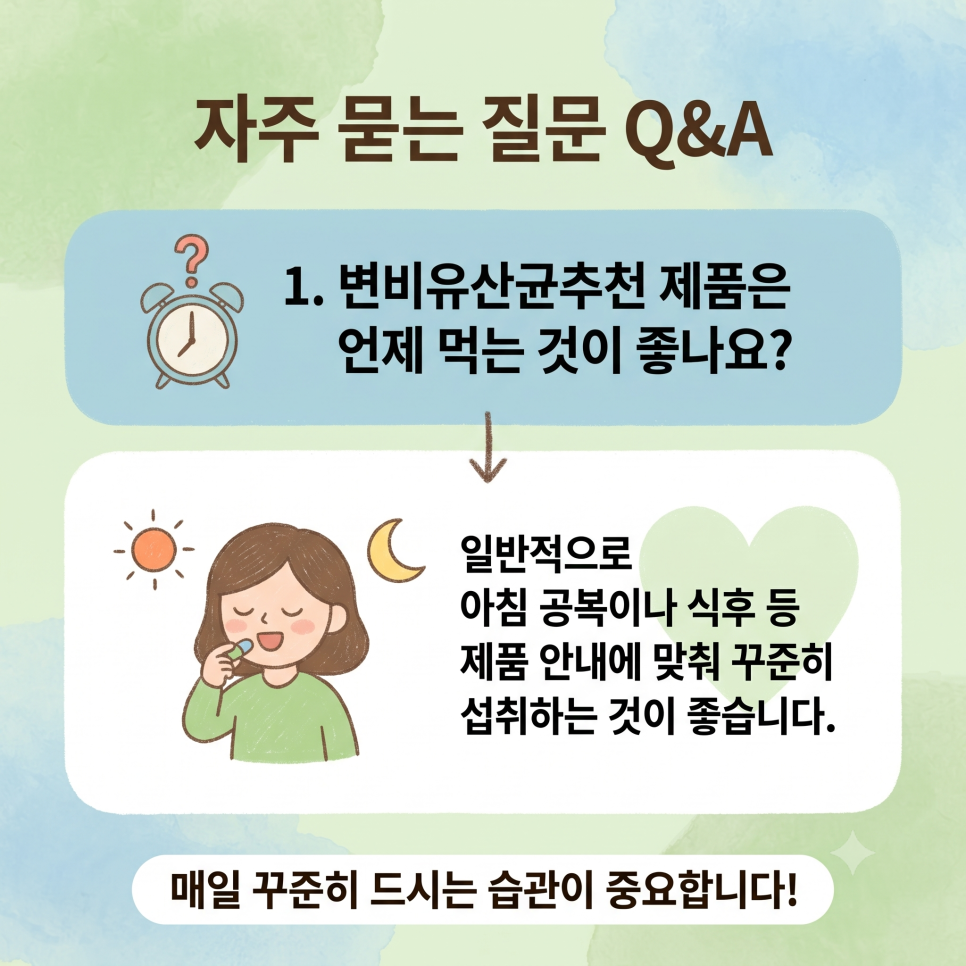
1. When’s the best time to take probiotics for constipation?
Recommended timing can vary by product, but generally, it’s best to take them consistently according to the product’s instructions — whether that’s on an empty stomach in the morning or after a meal.
2. How long does probiotic skin care take to show results?
Results vary by person, but many people report noticing changes after managing their gut health consistently for a month or more.

3. If my constipation is severe, can I just take more probiotics?
Taking more than the recommended amount doesn’t necessarily make it more effective. We’d recommend sticking to the intake amount listed on the product and taking it consistently.
4. Is there really a link between gut health and probiotic skin care?
Studies have reported that the balance of gut microbiota can influence skin inflammatory responses, so it’s hard to say the two are unrelated.

References
· Salem I, Ramser A, Isham N, Ghannoum MA, “The Gut Microbiome as a Major Regulator of the Gut-Skin Axis,” Frontiers in Microbiology, 2018. Read more
· Medical Observer (메디칼업저버), “Can Probiotics Be Used to Treat Skin Conditions?,” 2021. Read more
If you’re dealing with persistent constipation or skin trouble, please consult a healthcare professional.